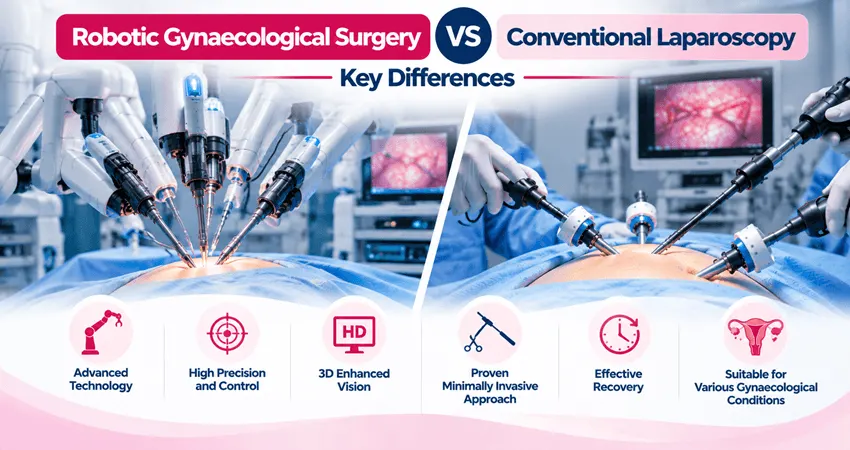
Robotic Gynaecological Surgery vs Conventional Laparoscopy: Key Differences
Advances in minimally invasive surgery have given gynaecologists different ways to perform procedures through small abdominal incisions. Two approaches are conventional laparoscopy and robotic-assisted gynaecological surgery. Both can be used for selected conditions, such as uterine fibroids, endometriosis and certain procedures involving the uterus or ovaries.
Although these approaches share the goal of performing surgery with smaller incisions than traditional open surgery, they differ in the instruments used, the way the surgeon controls them, visualisation and the equipment required.
Robotic surgery is not an independent or autonomous operation: the surgeon controls the robotic instruments throughout the procedure. Conventional laparoscopy is also performed by the surgeon, who directly manipulates long, specialised instruments while viewing the operating field on a monitor.
If you are considering minimally invasive gynaecological surgery in Pune, understanding the differences can help you ask informed questions and discuss the most appropriate approach for your condition.
What Is Conventional Laparoscopic Gynaecological Surgery?
Conventional laparoscopy, often called keyhole surgery, uses a thin camera called a laparoscope and specialised surgical instruments inserted through small incisions in the abdomen. The camera displays the pelvic organs on a monitor, allowing the surgeon to perform the planned procedure without making a large abdominal incision.
Depending on the diagnosis, laparoscopic gynaecological procedures may include:
Laparoscopic hysterectomy for selected conditions.
Laparoscopic myomectomy to remove suitable uterine fibroids while preserving the uterus.
Surgery for endometriosis and selected ovarian endometriomas.
Removal of certain ovarian cysts.
Other appropriate procedures involving the pelvic organs.
Conventional laparoscopy is an established minimally invasive technique. Its suitability depends on the patient's condition, the complexity of the operation and the surgeon's training and experience.
What Is Robotic Gynaecological Surgery?
Robotic-assisted gynaecological surgery is another form of minimally invasive surgery. The surgeon sits at a console and controls robotic instruments positioned inside the patient's body through small incisions.
The system typically provides a magnified three-dimensional view and instruments with wrist-like movement. These features can help the surgeon perform certain movements and suturing tasks in confined spaces.
Robotic systems may be considered for selected procedures, including some hysterectomies, myomectomies and operations for endometriosis. Whether robotic assistance is appropriate depends on the surgical complexity, patient factors, equipment availability, cost and the surgeon's specific training.
The robot does not diagnose the condition, make treatment decisions or perform the operation independently. The surgeon remains responsible for planning and carrying out the procedure.
Robotic Surgery vs Conventional Laparoscopy: Key Differences
1. Surgical Instruments and Control
In conventional laparoscopy, the surgeon holds and manipulates the instruments directly. In robotic-assisted surgery, the surgeon controls robotic instruments from a console.
Robotic instruments may provide greater wrist-like movement, which can be helpful for certain complex movements and suturing tasks. However, the benefit depends on the operation being performed and the surgeon's skill with the chosen technique.
2. Visualisation
Conventional laparoscopy uses a camera to display the operating field on a monitor. The image may be two-dimensional or three-dimensional, depending on the system.
Robotic systems commonly provide magnified three-dimensional visualisation. This can help with depth perception and anatomical detail, but improved visualisation does not automatically mean better outcomes for every patient.
3. Precision and Instrument Movement
Robotic instruments can offer a greater range of movement at the instrument tips and may help the surgeon perform complex suturing in confined spaces.
Conventional laparoscopy is also capable of precise surgical work when performed by a suitably trained surgeon. The practical difference depends on the procedure, anatomy and surgeon experience rather than the technology alone.
4. Incisions and Scarring
Both approaches generally use small abdominal incisions. The number and size of incisions depend on the operation, the equipment and the patient's anatomy.
Neither technique guarantees scar-free surgery. Both may require conversion to open surgery if unexpected findings or complications make this necessary for safety.
5. Recovery and Hospital Stay
Both robotic-assisted surgery and conventional laparoscopy are minimally invasive approaches. Recovery depends on the procedure, the patient's health, the extent of surgery and any complications.
For many benign gynaecological conditions, studies have not consistently shown that robotic surgery provides a shorter recovery or better outcomes than conventional laparoscopy. Compared with open abdominal surgery, either minimally invasive approach may offer benefits such as smaller incisions and an earlier return to everyday activities when clinically appropriate.
6. Cost and Availability
Robotic surgery requires specialised equipment, maintenance and a trained surgical team. Depending on the hospital and procedure, it may cost more than conventional laparoscopy.
Conventional laparoscopy is more widely available and may be more economical in many settings. Patients should ask for an itemised estimate and compare the expected benefits, risks and alternatives rather than choosing a procedure solely because it uses newer technology.
Comparison Table: Robotic Surgery vs Conventional Laparoscopy
| Feature | Robotic gynaecological surgery | Conventional laparoscopy |
|---|---|---|
| Surgeon control | Surgeon controls instruments from a console | Surgeon directly manipulates the instruments |
| Instrument movement | Wrist-like robotic movement | Movement depends on conventional laparoscopic instruments |
| Visualisation | Typically magnified 3D view | Camera view; 2D or 3D depending on equipment |
| Incisions | Usually small | Usually small |
| Recovery | Depends on procedure and patient factors | Depends on procedure and patient factors |
| Cost | May be higher due to equipment and related costs | Often less expensive, depending on the setting |
| Best use | Selected cases where robotic assistance may be useful | Many routine and complex procedures when suitable and supported by expertise |
Neither approach is universally superior. The choice should be based on the condition being treated, the expected clinical benefit, the surgeon's expertise and the patient's preferences.
Which Gynaecological Conditions Can Be Treated With These Approaches?
Both conventional laparoscopy and robotic-assisted surgery may be used for selected gynaecological procedures.
Uterine Fibroids
Myomectomy removes fibroids while preserving the uterus. Robotic assistance may be considered for selected cases where instrument movement and suturing could be useful. Conventional laparoscopic myomectomy is also an established option for appropriately selected patients.
Endometriosis
Laparoscopy can be used to treat visible endometriosis lesions and adhesions. Robotic assistance may be considered in some complex cases, but evidence does not establish that it is better for every patient with endometriosis.
Hysterectomy
Both conventional laparoscopic and robotic-assisted approaches can be used for selected hysterectomies. The best route depends on the diagnosis, uterine size, anatomy, previous surgery, other medical factors and the surgeon's experience.
Ovarian Cysts
Many ovarian cysts can be assessed and treated using conventional laparoscopy when surgery is necessary. Robotic assistance is not automatically required for straightforward ovarian cyst procedures. The surgical plan depends on the cyst's characteristics and the patient's clinical needs.
The appropriate approach varies by procedure. Robotic technology should be selected when it is expected to offer a meaningful benefit, not simply because it is available.
Are There Any Risks or Limitations?
Both robotic-assisted surgery and conventional laparoscopy carry risks associated with anaesthesia and abdominal or pelvic surgery. These may include bleeding, infection, blood clots, injury to nearby organs, and the need to change to open surgery.
Robotic surgery has additional practical considerations, such as equipment availability, cost, setup time and the need for procedure-specific training. Conventional laparoscopy also requires advanced technical skill and may be challenging in some complex cases.
No surgical approach guarantees a complication-free outcome. Your gynaecologist should explain the risks relevant to your condition, the expected benefits, alternative treatments and what would happen if the planned approach needs to change during surgery.
Is Robotic Surgery Better Than Conventional Laparoscopy?
Not necessarily. Robotic surgery offers technological features that may be useful in selected cases, but current evidence does not establish that it consistently produces better outcomes than conventional laparoscopy across all benign gynaecological procedures.
The American College of Obstetricians and Gynecologists advises that robotic-assisted procedures should be selected according to the likelihood of improved outcomes for the individual patient, taking account of case complexity, patient factors, surgeon experience and cost.
For some operations, conventional laparoscopy may provide equally appropriate treatment with lower equipment-related costs. For other cases, robotic assistance may be considered useful because of the complexity of the procedure or the need for particular instrument movements.
The most important factors are appropriate patient selection, a well-trained surgical team, informed consent and a procedure that matches the patient's clinical needs.
How Do You Choose the Right Surgical Approach?
Before deciding on robotic surgery or conventional laparoscopy, discuss the following with your gynaecologist:
What is the exact diagnosis, and is surgery necessary?
What are the non-surgical and alternative surgical options?
Why is one approach recommended over the other in your case?
What experience does the surgeon have with the proposed procedure?
What are the likely benefits, risks and recovery expectations?
What is the total estimated cost, including hospital and equipment charges?
If you wish to become pregnant, how might the procedure affect fertility or future pregnancy?
Under what circumstances might the surgeon need to convert to open surgery?
These questions help you understand the reasoning behind the recommendation and make a decision based on evidence, safety and your personal priorities.
Why Consult Dr. Kapil Kanade for Gynaecological Surgery in Pune?
Choosing a gynaecological surgeon requires consideration of the diagnosis, the available treatment options and the surgeon's experience with the specific procedure being proposed.
Dr. Kapil Kanade is an obstetrician and gynaecologist with experience in laparoscopic gynaecological surgery. A consultation can help you review your symptoms, examination and scan findings, understand whether surgery is needed, and discuss the advantages and limitations of suitable minimally invasive approaches.
When considering robotic surgery, ask specifically whether the procedure is available and appropriate for your condition, what training and experience the surgeon has with that robotic system, and how the expected benefits compare with conventional laparoscopy. It is also important to discuss alternatives, potential complications, recovery and cost.
The goal is not to choose robotic surgery simply because it uses advanced technology. It is to select the approach that best fits your medical needs, the complexity of your condition and your treatment goals. A clear discussion with an appropriately trained gynaecologist can help you make an informed decision.
Conclusion
Robotic gynaecological surgery and conventional laparoscopy both offer minimally invasive ways to perform selected operations through small abdominal incisions. Robotic systems provide features such as wrist-like instrument movement and magnified three-dimensional visualisation, while conventional laparoscopy remains an established and effective option for many gynaecological procedures.
Robotic surgery is not automatically safer, faster or more effective for every patient, and it may involve additional costs. The right choice depends on the diagnosis, surgical complexity, patient factors, available equipment and the surgeon's training and experience.
If you are considering gynaecological surgery in Pune, consult a qualified specialist to review your options and understand the expected benefits, risks, recovery and costs of each suitable approach.
Medical disclaimer: This article is for general educational purposes only and does not replace a medical consultation, diagnosis or personalised treatment advice.