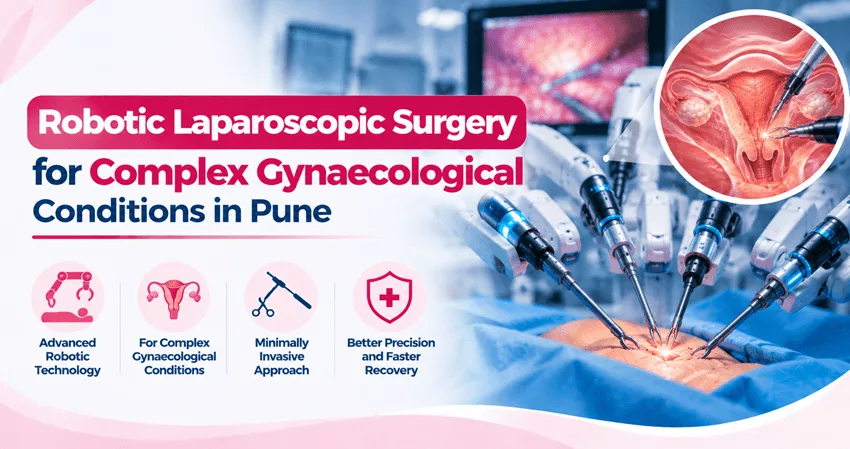
Robotic Laparoscopic Surgery for Complex Gynaecological Conditions in Pune
Some gynaecological conditions require complex surgical treatment because they involve large uterine fibroids, severe endometriosis, pelvic adhesions, an enlarged uterus, or disease affecting multiple pelvic structures. When surgery is necessary, the choice of approach can influence the procedure, recovery and potential risks.
Robotic-assisted laparoscopic surgery is a minimally invasive technique in which a surgeon controls specialised instruments using a robotic surgical system. The system can provide magnified three-dimensional visualisation and articulated instrument movement, helping the surgeon perform selected procedures through small abdominal incisions.
Robotic surgery is not required for every gynaecological condition, and it is not automatically better than conventional laparoscopy. The appropriate approach depends on the diagnosis, the complexity of the operation, the patient's medical history, the surgeon's training and experience, and the availability of suitable facilities.
Patients looking for advanced gynaecological surgical care in Pune can discuss their treatment options with Dr. Kapil Kanade, an Obstetrician and Gynaecologist with experience in gynaecological laparoscopic surgery.
What Is Robotic Laparoscopic Surgery?
Robotic-assisted laparoscopic surgery is a form of minimally invasive surgery. The surgeon operates from a console that controls robotic instruments positioned inside the patient's abdomen. The robotic system does not perform the operation independently; the surgeon remains in control of the instruments throughout the procedure.
A camera provides a magnified view of the surgical area, while specialised instruments can offer a wide range of precise movements. These features may be useful during selected procedures that require detailed dissection, suturing or work in confined pelvic spaces.
The suitability of robotic surgery depends on the individual case. Conventional laparoscopy, vaginal surgery, open surgery and non-surgical treatment may be more appropriate in other circumstances.
What Are Complex Gynaecological Conditions?
Complex gynaecological conditions are disorders that may require detailed assessment or technically demanding treatment. Examples include:
Large or multiple uterine fibroids
Deep or extensive endometriosis
Severe pelvic adhesions from previous surgery or inflammation
Selected cases requiring hysterectomy
Certain conditions involving the uterus, ovaries or surrounding pelvic structures
Cases where previous surgery or the anatomy of the pelvis makes an operation more challenging
Complexity does not automatically mean that robotic surgery is necessary. A specialist should assess the condition and determine which treatment approach offers the most appropriate balance of safety, effectiveness and recovery.
Conditions That May Be Managed With Robotic-Assisted Gynaecological Surgery
1. Uterine Fibroids
Uterine fibroids are non-cancerous growths that develop in or around the uterus. Depending on their size, number and location, they may cause heavy menstrual bleeding, pelvic pressure, pain or fertility-related concerns.
For selected patients who wish to preserve the uterus, myomectomy may be considered to remove fibroids. In other circumstances, hysterectomy may be an option when symptoms are severe and future pregnancy is not desired.
Robotic-assisted surgery may be considered for selected technically challenging cases, but the decision depends on fibroid characteristics, the patient's goals and the surgeon's expertise. Medication, conventional laparoscopy, open surgery and other treatment options may also be appropriate.
2. Endometriosis
Endometriosis occurs when tissue similar to the uterine lining grows outside the uterus. It can cause painful periods, chronic pelvic pain, pain during intercourse and, in some patients, difficulty conceiving.
Surgery may be considered when symptoms remain significant despite other treatment or when specific complications or fertility-related factors warrant it. Robotic assistance can be useful in selected cases requiring detailed dissection, but it has not been established as universally superior to conventional laparoscopy for endometriosis.
Treatment should account for disease location, symptom severity, fertility goals and the potential risks of surgery.
3. Pelvic Adhesions
Pelvic adhesions are bands of scar tissue that can cause organs or tissues to stick together. They may develop after previous surgery, infection, inflammation or endometriosis.
When adhesions cause significant problems or interfere with another necessary operation, a surgeon may consider adhesiolysis to separate the scar tissue. Robotic assistance may be considered in selected complex cases, depending on the anatomy and surgical requirements.
Adhesiolysis can carry risks of bleeding or injury to nearby organs, and adhesions may recur after surgery. Not every adhesion requires treatment.
4. Hysterectomy for Selected Conditions
A hysterectomy is an operation to remove the uterus. It may be recommended for selected patients with conditions such as symptomatic fibroids, adenomyosis or other uterine disorders when appropriate alternatives have been considered.
Robotic-assisted hysterectomy is one possible surgical approach. Conventional laparoscopy, vaginal hysterectomy or open surgery may be preferable depending on the patient's anatomy, the reason for surgery, the extent of disease and the surgeon's training.
The decision should include a discussion of risks, expected recovery, alternatives and the fact that pregnancy cannot be carried after the uterus is removed.
5. Other Selected Pelvic Procedures
Some other gynaecological procedures may require detailed work around pelvic structures. Robotic assistance may be considered when the surgeon believes its features are likely to be useful for the specific operation.
The use of robotic technology should be guided by clinical need rather than the assumption that more advanced equipment always produces a better outcome.
Potential Benefits of Robotic Laparoscopic Surgery
For selected procedures, robotic assistance may offer:
Magnified Three-Dimensional Visualisation
The camera system provides a magnified view of the surgical field, which may help the surgeon assess pelvic anatomy during complex procedures.
Articulated Instrument Movement
Robotic instruments can move through a range of angles that may help with suturing and dissection in confined areas. The usefulness of this feature depends on the operation and the surgeon's experience.
A Minimally Invasive Approach
When appropriate, robotic-assisted surgery may allow a procedure to be performed through small abdominal incisions rather than a large abdominal incision. Minimally invasive approaches can offer benefits such as shorter hospital stays and a quicker return to normal activities compared with open surgery in suitable patients.
Support for Selected Complex Operations
The robotic platform may be useful in some operations involving difficult anatomy or technically demanding suturing. However, these potential advantages do not mean that robotic surgery is necessary or superior for every patient.
Robotic Surgery vs Conventional Laparoscopic Surgery
Both approaches are minimally invasive and are performed by a surgeon. The main difference is how the surgical instruments are controlled.
| Feature | Robotic-assisted laparoscopy | Conventional laparoscopy |
|---|---|---|
| Instrument control | Surgeon controls robotic instruments from a console | Surgeon directly controls laparoscopic instruments |
| Visualisation | Usually magnified three-dimensional imaging | Imaging depends on the laparoscopic system used |
| Instrument movement | Articulated robotic instruments | Conventional laparoscopic instruments |
| Availability and cost | Depends on facility and robotic system; may cost more | Depends on the hospital and procedure |
| Clinical outcomes | Depends on the condition, procedure and surgeon | Also depends on the condition, procedure and surgeon |
Neither method is automatically the best option for every patient. The choice should be based on clinical evidence, the nature of the operation, the surgeon's competence with the chosen technique and the patient's preferences.
Is Robotic Surgery Suitable for Every Patient?
No. Robotic surgery is not necessary for every gynaecological condition. Some procedures may be performed effectively with conventional laparoscopy, vaginal surgery or other approaches. Some patients may need open surgery because of their anatomy, disease extent, medical history or other clinical factors.
Before recommending a surgical approach, the treating team may review:
The exact diagnosis and severity of the condition
The size and location of fibroids or other abnormalities
Previous abdominal or pelvic surgeries
Other medical conditions and anaesthesia-related risks
Future pregnancy plans and fertility preferences
The surgeon's experience and available hospital facilities
Expected benefits, risks, alternatives and costs
Patients should ask their surgeon why a particular approach is recommended and what alternatives are available.
How to Prepare for Robotic Gynaecological Surgery
Preparation depends on the planned operation and the patient's health. The medical team may review imaging, laboratory tests, medical history, allergies and current medication.
Patients should tell their doctor about blood-thinning medicines, previous anaesthesia complications, relevant medical conditions and any possibility of pregnancy. Medication should not be stopped without medical advice.
The surgeon and anaesthesia team will explain fasting instructions, the procedure, possible complications, expected hospital stay and postoperative care. Patients should also discuss the possibility that the planned approach may need to change during surgery if unexpected findings or safety concerns arise.
Recovery After Robotic Laparoscopic Surgery
Recovery depends on the procedure performed, the patient's general health and whether complications occur. A minor procedure and a complex hysterectomy can have very different recovery timelines.
Immediately After Surgery
Patients are monitored as they recover from anaesthesia. Temporary tiredness, abdominal discomfort, bloating or shoulder-tip pain may occur. The care team will provide instructions for pain relief, movement, wound care and eating and drinking.
Returning to Daily Activities
Gentle movement is often encouraged as recovery allows. Patients should gradually increase activity according to the discharge instructions. Driving, work, strenuous exercise, heavy lifting and sexual activity should resume only when the treating team advises that it is safe.
Follow-Up Appointments
Follow-up allows the doctor to assess healing, review any pathology results and address concerns. The timing of return to normal activities depends on the operation and individual recovery.
Warning Signs After Surgery
Seek prompt medical assessment for fever, worsening abdominal pain, persistent vomiting, heavy bleeding, difficulty passing urine or increasing redness or discharge from an incision. Sudden chest pain or breathlessness requires emergency medical care.
Risks and Limitations of Robotic Gynaecological Surgery
Robotic-assisted surgery is still surgery and carries risks. Depending on the procedure, these may include bleeding, infection, blood clots, anaesthesia-related complications and injury to nearby organs such as the bowel, bladder, ureters or blood vessels.
Other limitations include equipment availability, potentially higher costs, the need for appropriate training and the possibility that a planned minimally invasive procedure may need to be converted to another approach.
Robotic assistance does not guarantee less pain, fewer complications, faster recovery or better long-term outcomes than conventional laparoscopy. Patients should receive a clear explanation of the likely benefits and risks for their particular operation.
Fertility Considerations Before Gynaecological Surgery
Fertility goals are especially important when surgery involves the uterus, ovaries or fallopian tubes. Some procedures, such as myomectomy, aim to preserve the uterus, while hysterectomy permanently removes the ability to carry a pregnancy.
The effect of surgery on fertility depends on the underlying condition, the organs involved and the procedure performed. Patients who hope to become pregnant should discuss reproductive goals before surgery and ask whether fertility-preserving alternatives are appropriate.
When necessary, a gynaecologist may recommend consultation with a fertility specialist to discuss the potential benefits, limitations and timing of treatment.
Why Consult Dr. Kapil Kanade for Gynaecological Surgical Care in Pune?
Choosing a gynaecological surgeon involves more than selecting a particular technology. Patients need an accurate diagnosis, a clear explanation of treatment alternatives and a surgical plan tailored to their condition and personal goals.
Dr. Kapil Kanade is an Obstetrician and Gynaecologist in Pune with experience in gynaecological laparoscopic surgery. His professional profile describes fellowship training in advanced laparoscopy in Germany and fellowship training in infertility.
A consultation can help patients review their symptoms and investigation reports, understand the available treatment approaches and discuss the possible benefits and limitations of minimally invasive surgery. Relevant questions include whether surgery is needed, whether robotic assistance is appropriate, what alternatives exist, how fertility may be affected and what recovery is likely to involve.
Important: Experience in conventional laparoscopic surgery does not by itself establish specific robotic-surgery credentials. Patients considering robotic-assisted surgery should verify the surgeon's training and experience with the robotic platform and procedure being proposed. The availability of robotic surgery and the surgeon's role in performing it should be confirmed directly before making a treatment decision.
Conclusion
Robotic laparoscopic surgery can be a useful option for selected complex gynaecological procedures, including certain operations for fibroids, endometriosis and hysterectomy. Its potential benefits include magnified visualisation and flexible instrument movement, but it is not automatically superior to conventional laparoscopy or other surgical approaches.
The most appropriate treatment depends on the condition, surgical complexity, patient preferences, fertility goals, surgeon expertise and available facilities. Patients exploring complex gynaecological surgery in Pune should seek an individual consultation and discuss the benefits, limitations, risks, costs and alternatives before deciding on treatment.
Medical disclaimer: This article is for general educational purposes only and does not replace a medical consultation, diagnosis or personalised treatment advice.